
Jul 23. We have an uneventful flight from Kashgar to return to Urumqi and check into the newly built Sheraton Hotel. A mind-boogling modern hotel in the hinterlands of China with some of the best rooms we’ve had on the trip.
Kashgar Photo Gallery
Sam's Journal- Day 14 Kashgar/Opal
Jul 23
Monday. We Visit the Tomb of Yussup Hazi Hajup, a favorite son of Kashgar. He was a thinker and poet (The Knowledge of Happiness). Then our bus heads out for a one hour ride to the town of Opal so that can take in their Monday market.
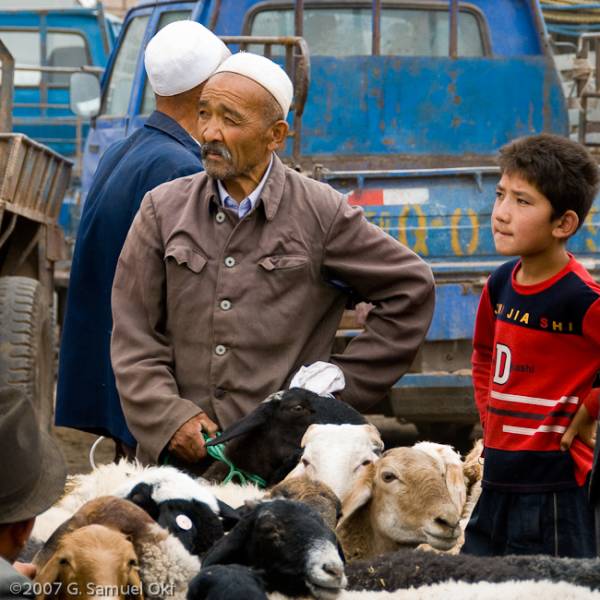
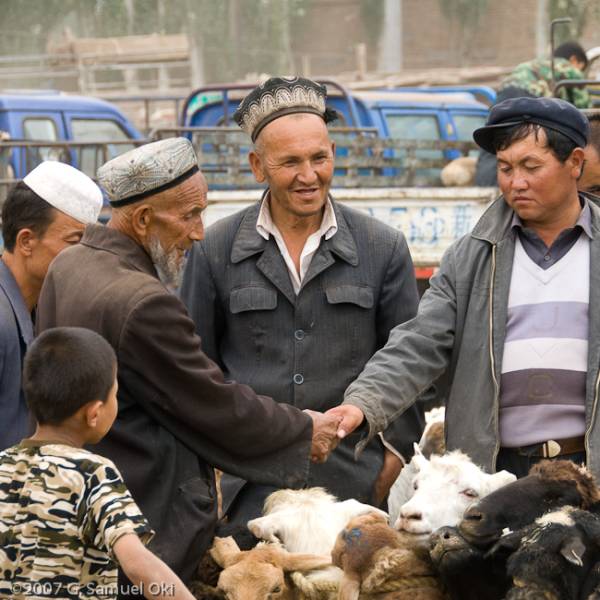
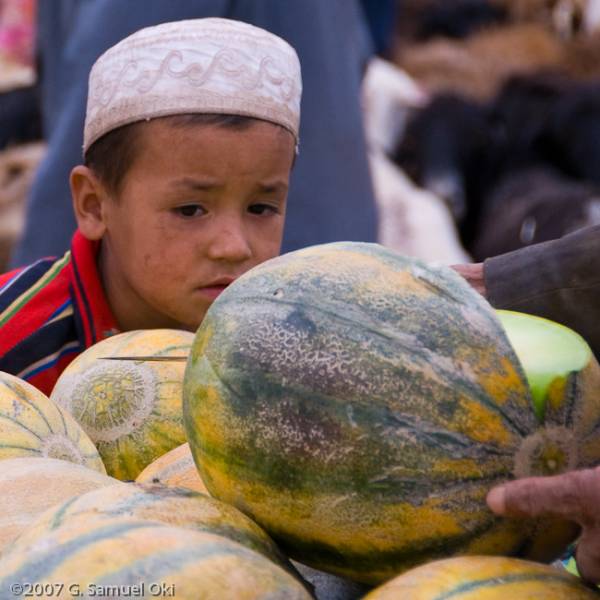
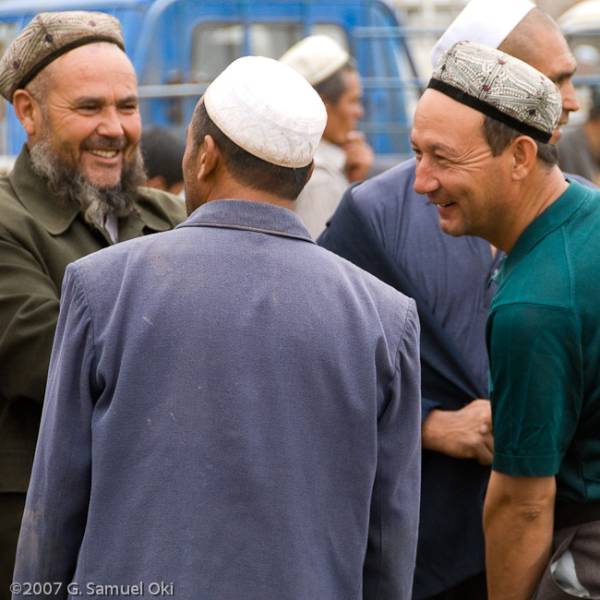
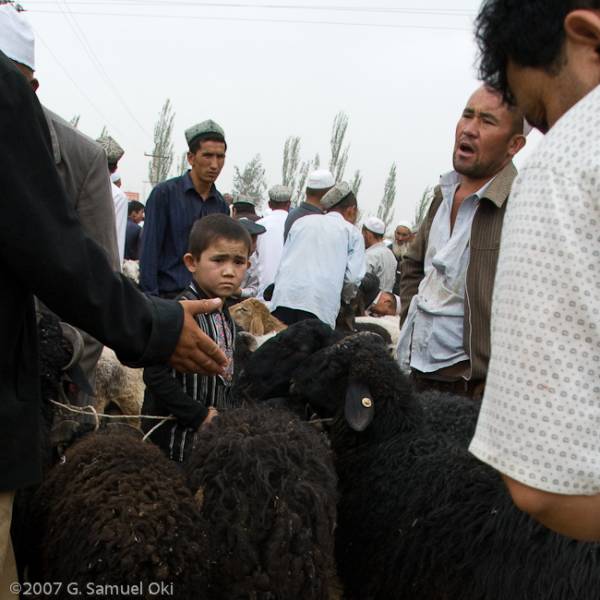
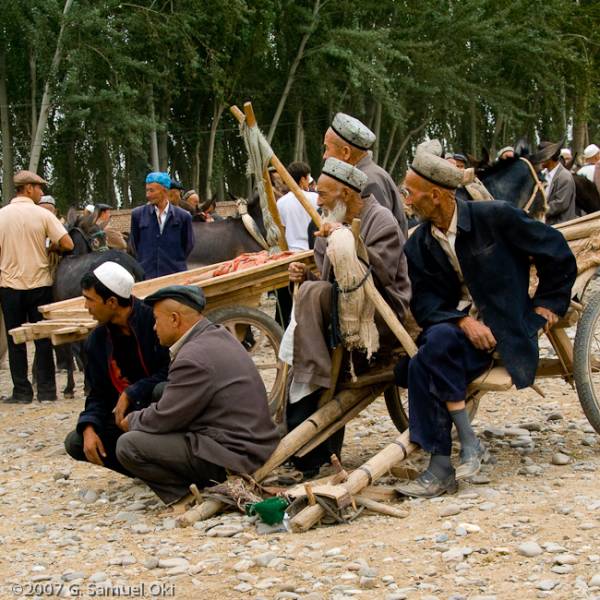
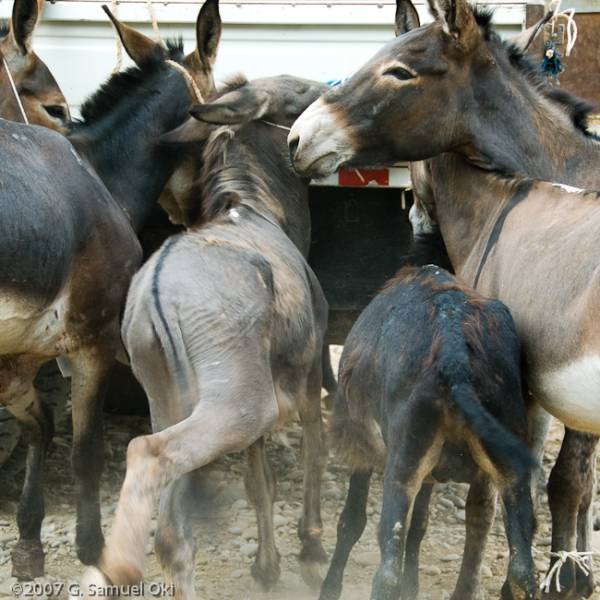
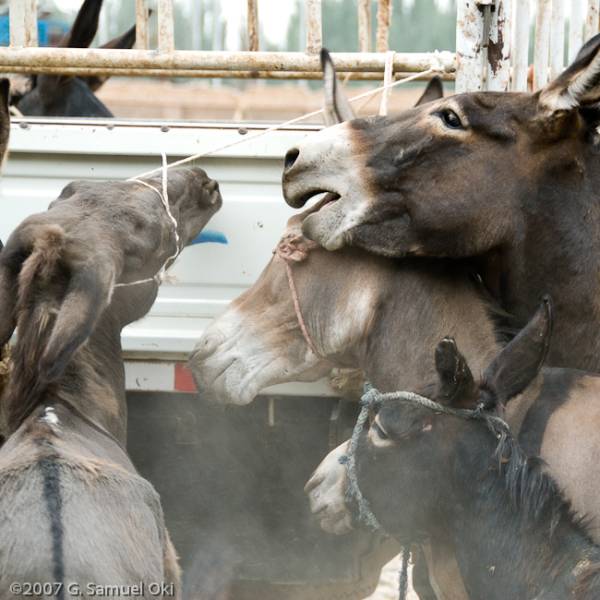
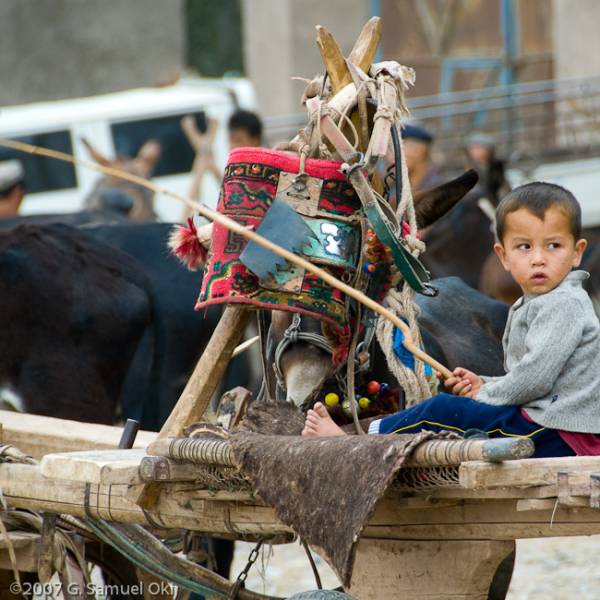
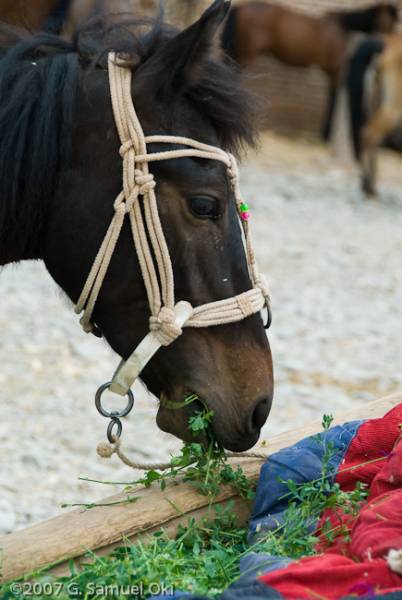
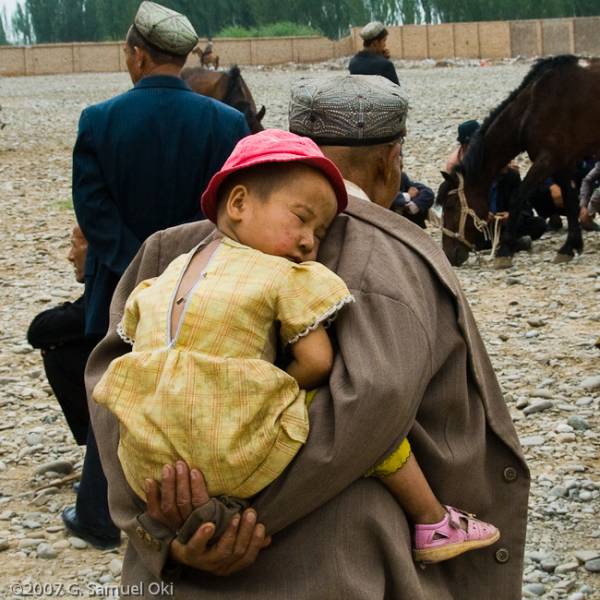
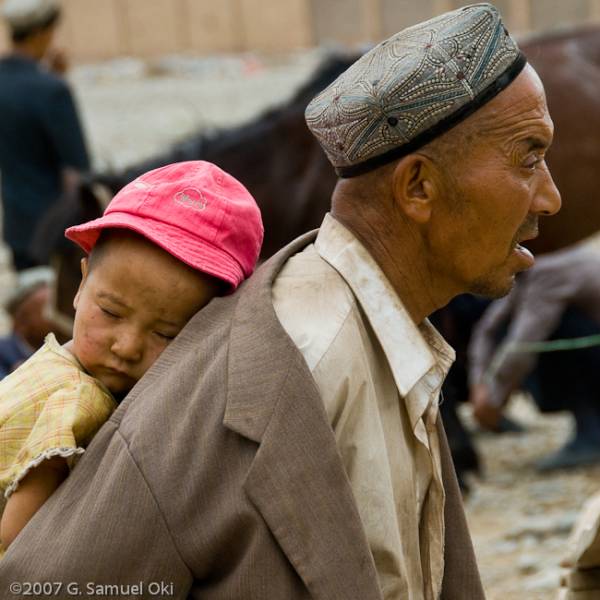
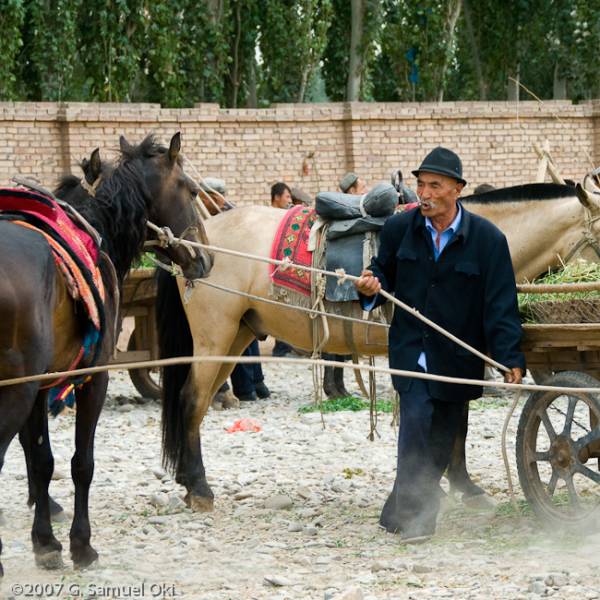
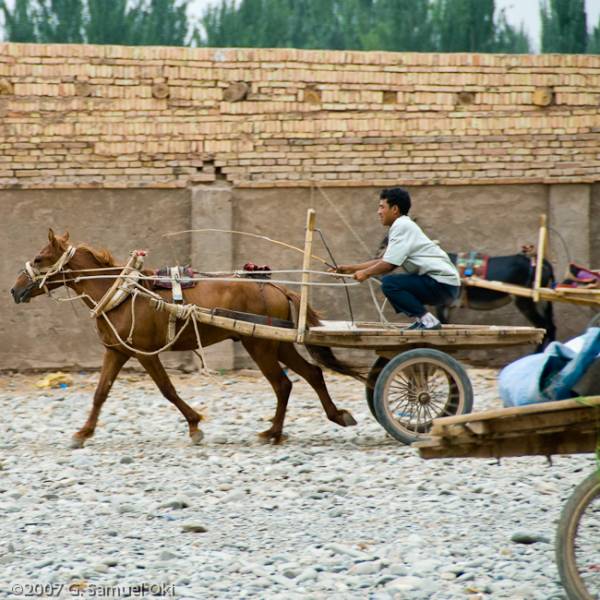
Our bus parks on the side of the road. Below us is an area the size of a football field with livestock grouped in numerous huddles surrounded by people. We have arrived at the Opal Market. This is what the Kashgar Market looked like years ago in its infancy. Some member of our group watch as negotiations ensue for the purchase of four lambs. There is ten minutes of back and forth offers and counter-offers punctuated crowds rooting for the buyer or seller for reasons that are lost to us in translation. A deal is struck all parties wear broad smiles, shake hands, and exchange money for the four sheep. The final price- 275 CNY each or roughly $36.
Rick and I hunt down Imam and reinitiate our request from the previous day- We would like to buy a lamb. He looks at us with a cocked head, probably thinking either these guys are pulling my leg or asking himself why he gets all the delusional toursits from the U.S. Rick and I pressed him once more with our request. Then Rick hits the magic button and says, “We would like to buy a lamb to give to your mother.” Imam’s eyes light up and yells back to us, “Wait here. I will be right back!” as he is running back up to the road. Ten minutes later he returns and says, “Ok, we are set. I had to arrange for transportation back to Kashgar. I found a truck and driver that will take the lamb.” I tell Imam that the price we are willing to pay for a single lamb is the price is 275 CNY. The same amount that we just witnessed paid per animal when a total of four lambs were purchased; we wanted the “volume discount” for the single unit purchase. Rick, Bruce, and I quickly put our cash together and Imam went to work his magic.
So after much haggling, this more of a negotiation with audience participation, the deal was struck; 275 CNY for one black lamb. I proceed to hand Imam the money for payment and upon the seller’s recognition that we foreigners were funding the buy he says, “I would have stuck to 280 CNY (about 70 cents US)!” Imam tells him that we are buying the lamb as a gift for his mother. The buyer’s face breaks into a smile and the crowd shout words of congratulations. Or so that is the translation that we got and we’re sticking by it since it makes for a good story.
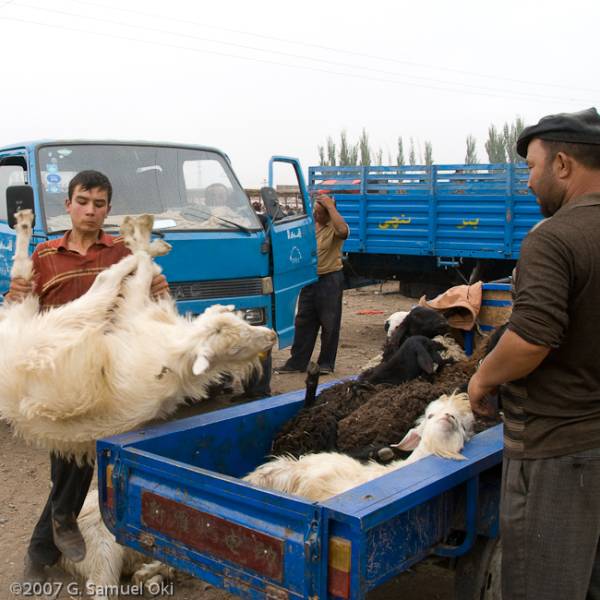
After finishing our tour of the market, we head back to the bus and we relate the happenings to the bus driver. He asks, “So where is this lamb?” We tell him that it is in the truck to be taken back to Kashgar. After an exchange of a few words between the driver and Imam; Imam shoots out the door, runs down the street, and returns with the lamb. Apparently the driver is ok with taking the lamb on the bus. And that is how we ended up with a lamb tied to a lead-rope standing in the footwell of the bus door driving an hour back from Opal to Kashgar.
By the time we arrive in Kashgar, arrangements have already been made by Imam to have a friend pick up the lamb. We wonder where the lamb will be kept while in the city and until Imam can take it to his village. A vague answer is given but it sounds like this lamb is about to experience Kashgar city life in an apartment. What a day. Taken to market from home. Sold off. Put on a truck and then a bus. Tied to the bumper of a bus in a big city. Taken for another ride on a motorcycle and put “out to pasture” in an apartment. And we though we were the ones having a lifetime experience!
Leaving the lamb behind, we head for lunch at a local family’s home. Down another series of small streets and into the courtyard entry. You can’t tell what is to be found inside, by looking at the exterior walls. We enter the courtyard door and are immediately greeted by the matriarch of the family. Our group is given the traditional handwashing and escorted to a room that is about 40 feet by 20 feet in size. There is a large table filled with food. The ceiling has exquisite crown moulding that has a finish that reminds me of Russian lacquered boxes. Pillows and draperies are detailed with embroidery. We have a wonderful lunch and leave wishing that there had been more interaction with our hosts.
Off to the airport and on to Urumqi.
Sam's Journal- Day 12 Kashgar
July 22.
Sunday our main event is to see the Sunday Kashgar Market. But before heading there we visit the Id Kah Mosque with architecture in the Central Asian style. It is estimated that it was founded in 1738 but badly damage during the Cultural Revolution.
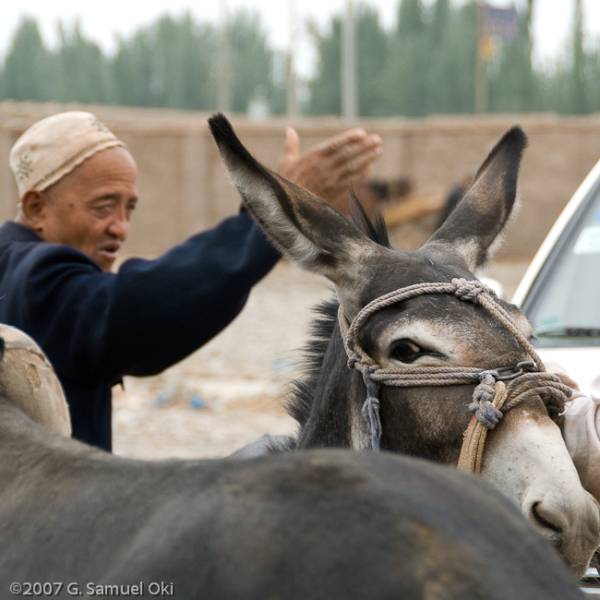
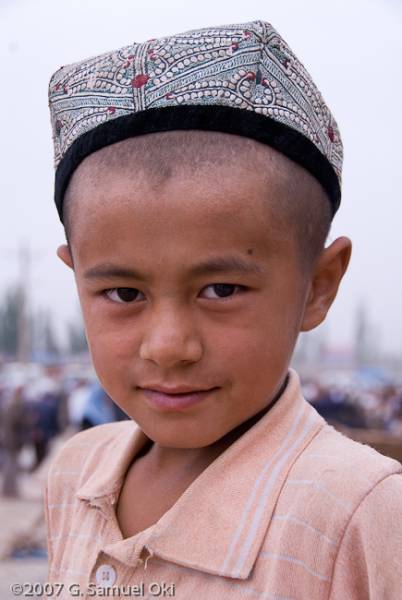
The Sunday Market does not disappoint. The market has grown too large and now the livestock market and the merchandise are split into two locations a few miles apart. We spend a couple of hours wandering through the livestock market and it is a treasure trove for me to photograph. Lots of unique faces, action, and customs. Imam comes to drag Rick and me back to the bus. We ask him if we can buy a lamb. “No, not enough time. We must go.” he says, only half listening and thinking we are pulling is leg.
Off we go to the main market. After a quick walk through and then a briefing on the layout of the market, the meeting time, and rendezvous point; we are set free to be on our own. I mainly play observer and watch the crowd shop and our group buying souvenires. Jason and I join up to find and bargin for a spice, we are told it is lachindana, that was put into our black tea the evening before. We find two spice vendor in close proxmity, start to negotiate, and buy a kilogram of cultivated lachindana (vs wild) for 750 CNY (about $10). Our purchase is completed just in time to make it back to the meeting place on time to head back to the bus and lunch.
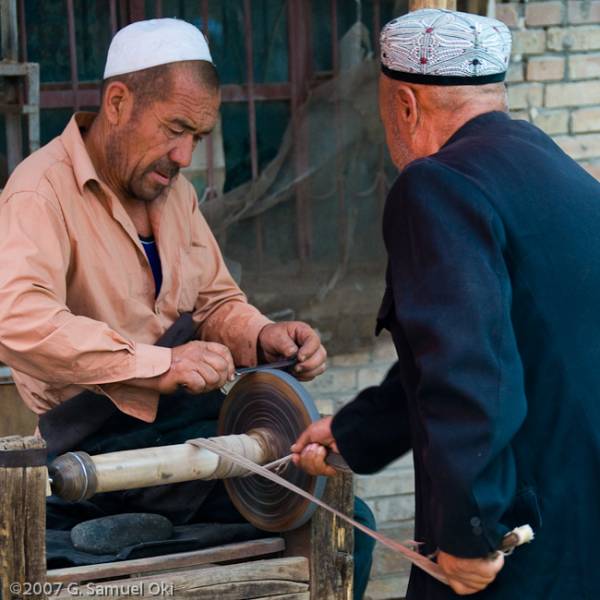
After a great meal of pilaf, lamb shish kabobs, noodles, and fruit. We visit the Tomb of the Abakh Hoja Family which is an example of Islamic architecture. The monument is also know as the burial place of the “fragrant concubine” Xiangfei, who was captured by the Qianlong emperor and taken to Beijing. Rather than seeing another city ruin, we are rescheduled to take a walking tour of the old town section that is where manyof the local Uyghur population take residence. We enjoy our encounter with children playing in the narrow streets, learning that large cobble stones signify that the street is a through street and that small cobbles are indicative of deadend streets, and observing local vendors and manufacturers practicing their trades.
Dinner is at a hotel/restaurant that was once the British embassy and we take in a local performance of singers and dancers.
Sam’s Journal- Day 11 Kashgar
Jul 21.
We arrive in Kashgar on Saturday evening and take in a light dinner at a “Chinese” restaurant. Jason, our national tour director, and Imam, our local guide, are comparing notes and discussing tweaks to the itinerary…we have seen enough ancient city ruins. That communication turns out to be a good thing.
Sam's Journal- Day 10 Urumqi
Jul 21.
We depart Turpan the following morning heading to Urumqi by bus and then on to Kashgar that evening via airplane. But first, we visit the Xinjiang Provincial Museum and then Red Hill, where we get a panoramic view of Urumqi. The museum has displays that depict all the different ethinic groups in the Xinjiang Territory. You might have seen the special television presentation on Nova of the “Mysterious Mummies of China.” The mummies that are the subject of this program are on display here. The mummies at first were thought to be of Asiatic or Middle Eastern ethnic origin but DNA samples proved that the mummies were of caucasian origin. The history of the mummies really bring home what a center of trade this region was, how long ago these trade routes had been established, and how much more closely related we all are.
Turpan Photo Gallery


Sam's Journal- Day 9 Turpan
Jul 20.
Our second day includes Gaochang Ruins, Astana Tombs, the Flamming Mountains, Beziklik Caves, make a visit with a family in a local Uyghur village, and see the Karez irrigation system in the Grape Valley. We end up sampling some of the locally produced vine and then have dinner at a local family’s vineyard, dining outside next to thier home.
Interestingly, the niece of the family that is hosting the dinner, is visiting from her home in Austrailia. Everyone does a head snap when she introduces herself and a distinctly Austrailian accent bounds out of her mouth. Her family has left Xinjiang Province to try and establish a better life abroad.
Sam's Journal- Day 8 Turpan
Jul 19.
The train ride takes longer than we expected. In the morning, we watch as the scenery changes from desert to farmland and finally to an urban landscape. Along the way, evidence of yesterday’s rain and flooding are observed; wash outs, stranded cars, heavy equipment stuck in the mud.
Our disembarkation from the train is uneventful; we are all present and accounted for, along with our lugggage. We climb back into a bus, are on our way, and greeted by our local guide, Dolqun, with a, “I’m tickled pink to be able to be your guide.” Not what any of us expected as a greeting. We share sideways glances with each other and wonder, “What is this all about?” It turns out that Dolqun is practicing his English on us by using one of a couple of hundred English colloquialisms he has compiled. He is sincerely interested in improving his English and in sharing his Uyghur and Muslem culture with us. His second exchange is sharing Nan, a flat bread, with us- delicious.
We check in to the hotel and freshen up and have lunch. Then off to Jiaohe Ruins and Emin Minaret.
Dunhuang Photo Gallery


